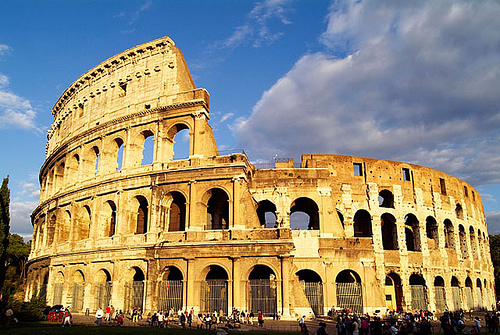

In ancient times had a capacity for 50,000 spectators, with eighty rows of gradas.1 2 3 The standing near the arena were the Emperor and Senate, and as they stood were located lower strata of society. Took place in the Coliseum gladiator fights and public spectacles. It was built just east of the Roman Forum, and construction began for 70 d. C. and 72 d. C., under the rule of Emperor Vespasian. The amphitheater, which was the largest ever built in the Roman Empire, was completed in 80 d. C. by the Emperor Titus, and was modified during the reign of Domiciano.4 Its inauguration lasted 100 days, participating in it all the Roman people dying in their celebration and dozens of gladiators and wild beasts who gave their lives for pleasure and entertainment of the people.
The Colosseum was used for nearly 500 years, celebrating the last games ever in the sixth century, much later than the traditional date of the fall of the Roman Empire in 476 AD C. As the gladiator fights, many other public spectacles were held here, as naumachias, hunting animals, executions, re-enactments of famous battles and dramas based on Classical mythology. The building ceased to be used for these purposes in the High Middle Ages. He was later reused as a refuge, factory, home of a religious order, strength and quarry. From its ruins was extracted abundant material for the construction of other buildings, until it was converted into a Christian shrine in honor of martyred prisoners during the early years of Christianity. This measure helped to stop the looting and ensure their conservation.
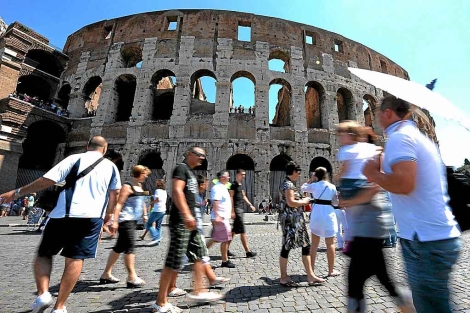
Although the structure is seriously damaged by earthquakes and stone-cutters, the Coliseum has always been seen as an icon of Imperial Rome and is one of the best preserved examples of Roman architecture. One of the most popular tourist attractions of modern Rome and is still closely linked to the Roman Catholic Church, so the Pope leads the ordeal to the amphitheater every Friday Santo.

No hay comentarios:
Publicar un comentario